
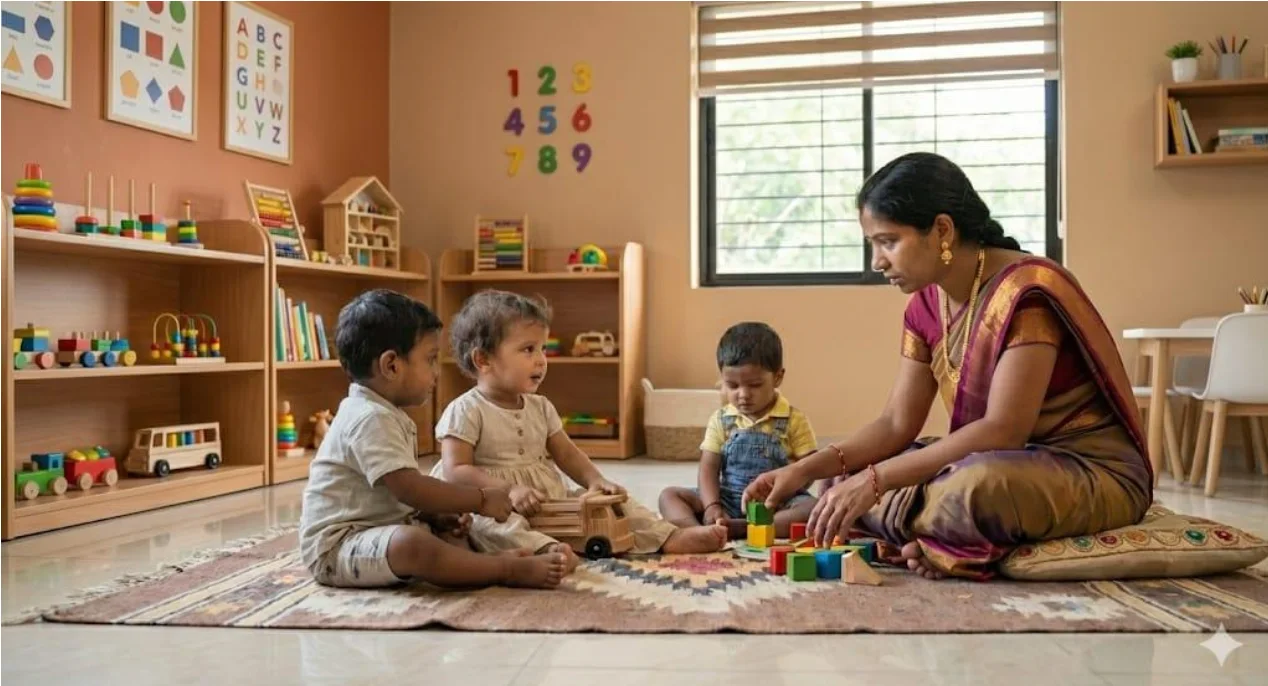
In recent years, concerns around the safety and well-being of very young children in childcare settings have become increasingly difficult to ignore. As more families rely on crèches, daycares, and preschools-driven by urbanisation, nuclear households, and rising female workforce participation-the early childhood care sector has expanded rapidly, often without commensurate attention to regulation, oversight, and professional standards.
What is particularly troubling is that risks to children are not confined to any one type of setting. They cut across informal neighbourhood daycares and reputed institutions alike, pointing to a systemic gap rather than isolated failures.
Child safety in early care environments cannot rest on goodwill, reputation, or parental vigilance alone; it requires enforceable standards, trained personnel, and accountable governance. This is not about a few errant individuals but a systemic governance gap. When safeguards fail in the early years, the consequences extend beyond immediate harm, affecting children’s developing brains and long-term well-being.
Abuse in the early years is toxic stress
Neuroscience is unequivocal: the early years, especially the first five, are when the brain’s core architecture is formed. Neural circuits governing emotional regulation, stress response, memory, language, and social behaviour develop through repeated interactions with caregivers and environments.
When young children experience violence, fear, or humiliation in care settings, their stress- response systems are activated repeatedly, leading to toxic stress-a state of chronically elevated stress hormones without the buffering presence of a trusted adult.
Toxic stress has measurable biological consequences, including disrupted brain connectivity, impaired executive function, heightened anxiety, and increased long-term risks of mental and physical health disorders. For toddlers and preschoolers, being hit, isolated, or threatened is not a disciplinary lapse but a neurological assault at a formative stage.
This is why childcare safety is not merely about preventing accidents-it is about protecting brain development itself.
What safety protocols exist-and why they are insufficient
The Ministry of Women and Child Development issued the National Minimum Standards and Protocol for Crèches, 2024, outlining minimum norms for infrastructure, hygiene, nutrition, staffing ratios, caregiving practices, and basic safety. They recognise that childcare involves health, emotional well-being, supervision, and dignity-not merely physical space. They align with global thinking on nurturing care. These cover some aspects, however, the problem lies not in intent but in status, scope, and enforcement.
First, these standards are guidelines, not binding law. They apply largely to crèches under government schemes or employer-provided facilities, leaving large segments of the childcare sector-private daycares, society run centres, and preschools operating as “activity centres” outside their mandatory ambit.
Second, India lacks a unified licensing and inspection authority for childcare. Oversight is fragmented across multiple departments-education, labour, women and child development, and municipal bodies-resulting in diffused responsibility and weak accountability.
Third, critical safety elements are missing or weakly articulated. The 2024 standards do not uniformly mandate criminal background checks, robust child-protection policies, trauma- informed caregiving practices, or public disclosure of compliance. As recent cases show, untrained or under-aged staff can still be employed, and abusive practices often surface only after harm occurs. These are not merely enforcement gaps; they are design failures.
Parents cannot substitute for regulation
In the absence of a strong regulatory system, parents are routinely advised to “do their homework”: check CCTV, ask about staff, assess hygiene, trust reputation. This shifts the burden of safety from the state to individual families and from public responsibility to private anxiety.
But childcare safety cannot depend on parental vigilance, social capital, or luck. Nor should it be determined by the fee one can afford. A child’s right to safety does not vary by neighbourhood or brand name.
Countries that take early childhood seriously treat childcare like other essential services: licensed, inspected, transparent, and accountable. India does this for schools, hospitals, and even food establishments. Why not for places that care for children too young to report abuse themselves?
What treating childcare safety as a public responsibility would mean
A serious policy response would include:
- Statutory backing to the 2024 National Minimum Standards, extending them to all childcare settings, which is, crèches, daycares, and preschools.
- A single nodal authority at the state level responsible for registration, licensing, inspection, and enforcement.
- Mandatory background checks, minimum training, and age requirements for all staff.
- Integration of psychological safety and child-protection protocols, not just infrastructure norms
- A public registry of licensed centres, inspection status, and compliance history
The question is no longer whether we know enough. It is whether we are willing to govern.
The cost of in-action
When a young child is harmed in care, the damage does not end with an FIR or inquiry. It travels forward-into classrooms, relationships, health systems, and society itself. Unsafe childcare undermines not only child rights but also women’s workforce participation, public trust, and long-term human capital. This is not a matter of choice but of obligation. The standards are on paper, the science is unequivocal, and the consequences of inaction are already playing out in children’s lives.
About the Author
Prof. (Dr.) Geeta Chopra is one of India’s leading voices in Early Childhood Development, disability inclusion, parenting, and child protection. After retiring as Professor from the University of Delhi, she founded the EveryChild EveryAbility (ECEA) Institute. Website: www.drgeetachopra.com